04/10/2025
Hurtigruten is a word you cant escape when you are visiting the Norwegian coast. The word literally means ‘The Fast Route’, but it’s one of those situations where the word has become more than just it’s meaning.
Hurtigruten History
Back in the late nineteenth century there were very few roads to link communities in the north of Norway. Many villages and towns could only be reached by boat. Various small companies operated routes between villages; taking passengers, goods and post. But these boats were not frequent, their timetables were not linked, and often the services reduced or stopped in the dark winter months.
The Norwegian government decided that a more reliable service was needed and invited shipping companies to tender for a route between Trondheim and Hammerfest. Captain Richard With had been running a steamship company for about ten years when he decided to bid for the route. Together with Anders Holte he mapped the route and developed navigational aids to allow boats to sail during the night. This meant that the route could be followed consistently regardless of the time of year.
And so in 1893 the Coastal Express service was born. The company continued to flourish, building more ships, acquiring other companies and expanding the route that now runs between Bergen in the south up to Kirkenes near the Russian border. These days the company is called Hurtigruten, named for the route it has travelled for over 100 years. It’s not the only company to operate this route (at the moment Havila also have a contract to offer Coastal Express voyages) but it’s the one that has the longest history and it’s the name that everyone recognises.
Things have changed since the route first started. There are many more roads, so ships are not as vital for trade and postal services. Now they are more geared towards tourism and offer an enhanced ferry service, or no frills cruise, all along the coast of Norway. Travellers can book port to port journeys or longer voyages taking in multiple destinations. They even offer a service to the distant islands of Svalbard.
The Hurtigruten Museum
Why all of this preamble to todays blog? This was the day when we visited the Hurtigruten museum. Based in Stockmarknes, this museum provides a history of the company and the iconic route. Everything from the way the company was established through to the modern fleet and encompassing the role of the ships in WWII, a time of heroics and tragedy.
Even better, the absolute hi-light of the museum, is the fact that it is built around one of the decommissioned ships of the fleet. The MS Finnmarken started to run the Coastal Express route in 1956 and was decommissioned in 1993. After some campaigning and significant fund raising the ship was acquired for the museum and the process of restoring it to its original 1950s glory. Around the ship is an impressive glass and steel building. The museum has a number of displays that explain the history of the museum which is an amazing story in its own right.
When you enter the museum you can access most of the ship, from the bridge to the cargo holds. You can visit the on board cafe and nose around the cabins, sit in the lounges or peer into the bathrooms. Most of the ship has been restored to it’s original 1950s fittings by volunteers, music is playing, and clever use of sound makes it seem as though there are people just behind the closed doors. We loved it and spent hours exploring. It’s easily a whole day out when you consider the fun of exploring the ship on top of taking in all of the historical exhibits and having a lunch on board. There is also a restored interior from 1912, consisting of a few cabins and state rooms. These have a more luxurious feel than the utilitarian 1950s ship with their beautiful polished timber fittings and art deco styling.

MS Finnmarken towering above us
-

- Some great period detail
-

- The post room – so important before the roads were improved
-

- Looking across the deck
-

- Cabin from the 1912 rooms
Stockmarknes
Stockmarknes is the largest settlement on the island of Hadseløya and is the location of the headquarters of the Hurtigruten company.

Across the bridge to Hadseløya
After visiting the museum, we took advantage of the town amenities to find some contact lens fluid as I was running low. We popped into the ‘Normal’ pharmacy, a chain we’d seen in many places with it’s distinctive cartoon logo. A few days later I found a spare bottle that I had stashed in a safe place. Oh well. There was no chance of running out now.
As my birthday was impending we also treated ourselves to a trip to the Vinmonopolet where my birthday present was a box of wine. Not to be drunk in one sitting.
We were considering staying overnight and drove up to some parking near a recreational area in Stockmarknes but didn’t feel comfortable staying overnight. It was a cemetery car park, quite small and on a bit of a slope. We did take a walk around the area though and saw there were a number of bike trails being enthusiastically enjoyed by children on the last few days of their autumn school holiday.
Melbu
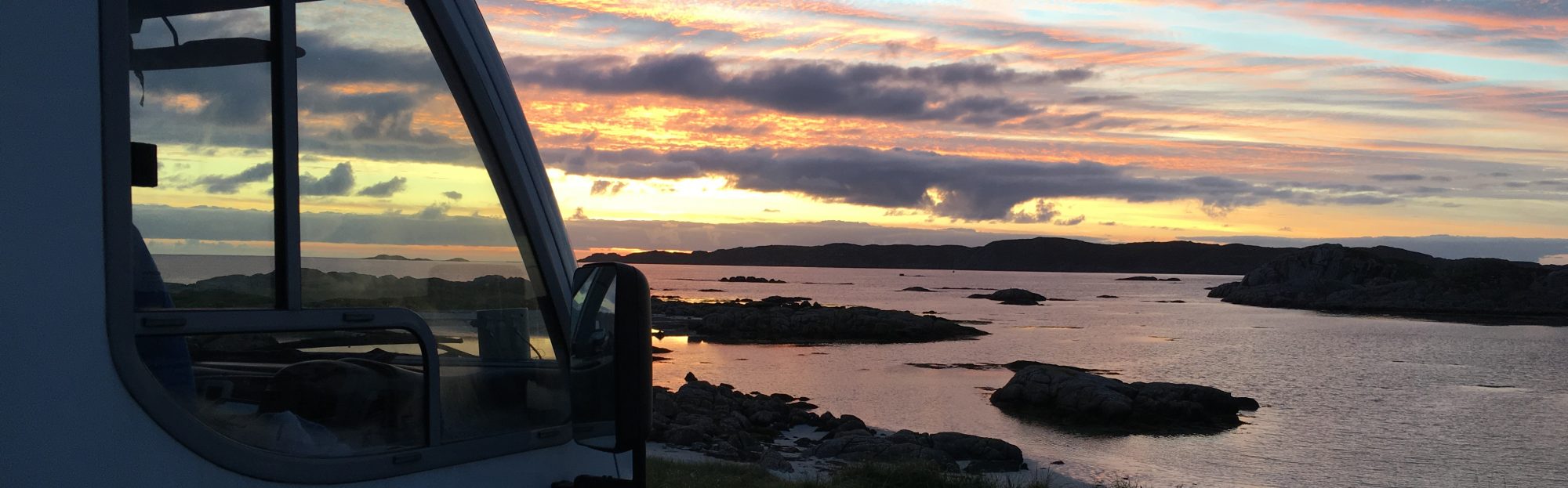
Instead of staying in Stockmarknes we drove around to the south side of the island where there is motorhome parking at the harbour in Melbu. Not only was this a lovely spot but we would also be set for the ferry the following day.
-

- Views across the water
-

- Sunset views
-

- across the harbour
Paul did some fishing from the harbour wall. Unfortunately he didn’t manage to catch anything to eat, but as the sun set he did catch a very odd specimen. A positively prehistoric looking fish that seemed to be all mouth. We think it was a Bullhead aka Sea Scorpion.

Interesting fish, well camouflaged against the rock
That night we had a few glimpses of aurora through the clouds. We played with the timelapse setting on our GoPro to capture the aurora, you can find the video clip somewhere on instagram or facebook.
Cycling from Melbu
Inspired by the bike trails in Stockmarknes, we decided we would plan a cycling route for the following day. Using the fantastic UT app and a bit of help from wikiloc we mapped out a route that would take us up and over the mountain ridge between Melbu and Stockmarknes and then would bring us back down to the bike trails and then around the lower slopes of the ridge to our parking spot.
It was a good plan, but strong winds meant we only executed part of it.
As we set off the sky was a glorious blue but we could already feel a strong breeze. We cycled up to the ridgeline on a tarmac road in the shelter of golden leaved trees. We could hear the wind whistling above us as we slogged uphill. Near the ridge we exited the woods and without any shelter we could feel the full force of the wind. It blasted us as we made our way to the mast on the nearest peak until eventually I had to get off my bike and push as my cycling legs weren’t strong enough to fight against it’s force. We huddled in the shelter of the building on the summit, deciding what to do next. We were experiencing the first gusts of Storm Amy which had already caused trouble in the UK and was now strengthening over Norway.
-

- Ascending through the trees
-

- On the exposed upper slopes
-

- View of Stockmarknes
-

- And the rest of the ridge. I didnt dare go any closer to the edge
-

- Heading back down
We decided that the only safe option was to return the way we had come. We didn’t want to tackle the off road descent to Stockmarknes in this weather. Even the return along the ridge was scary with the wind pushing us along the track and occasionally buffeting us sideways into the grass. We were relieved to find the shelter of the trees and speed down the road back to the van.
Back at the van we had showers in the harbour facilities building and then made up our minds to take the ferry straight away before the winds picked up even more. We drove the few minutes to the ferry port on the other side of the harbour, getting there just in time for the next ferry.

Crossing to Fiskebøl – we ventured on deck for a quick look before the biting wind drove us back inside again
We were finally on our way to Lofoten.